Post-War Era
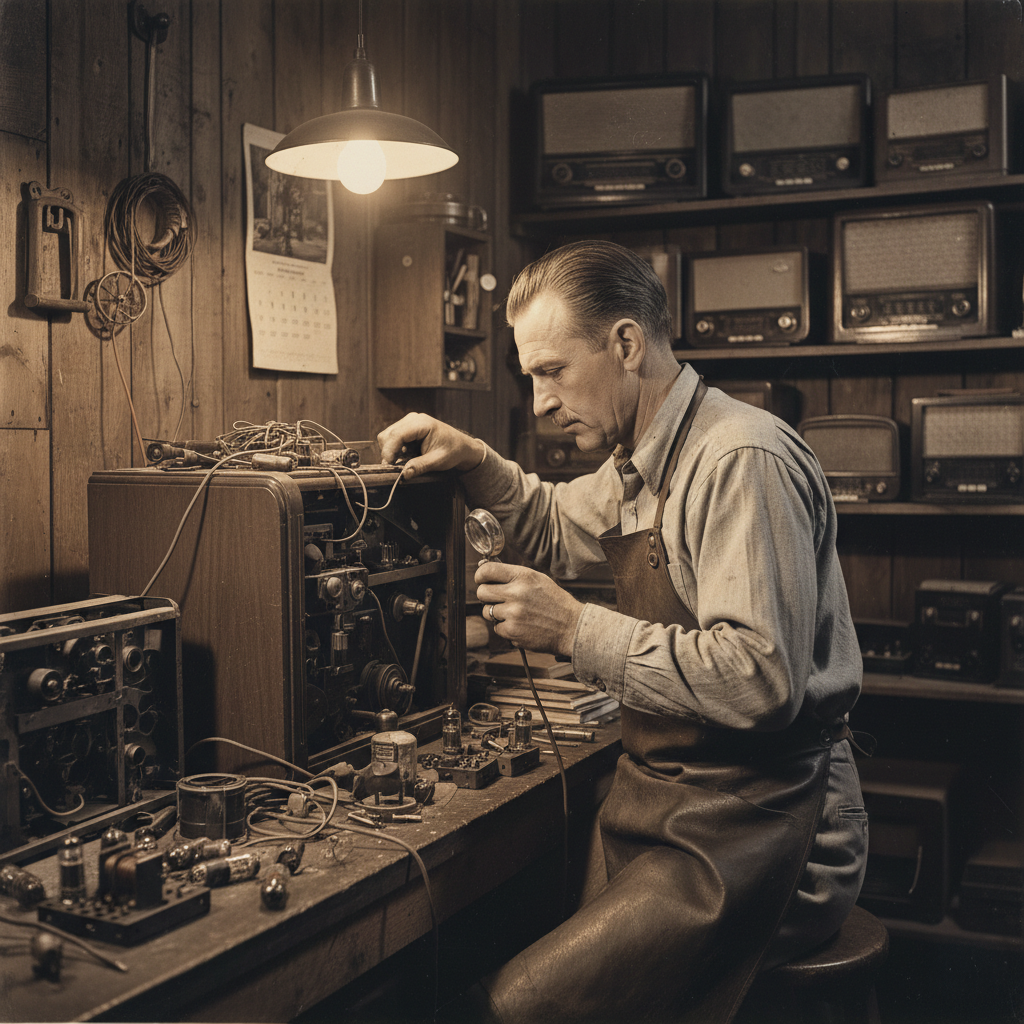
Radio Repairman
An extinct profession from Post-War Era that became obsolete due to technological advancement and societal change.
Media Gallery
Image

Post-War Era
An extinct profession from Post-War Era that became obsolete due to technological advancement and societal change.
The Radio Repairman was a vital figure in the mid-20th century, particularly in the post-World War II era when radio became a staple of American households. As the popularity of radio surged, so did the need for skilled technicians who could diagnose and fix the myriad of issues that could arise in these complex devices. Radio Repairmen were often found in small shops, bustling with the sounds of static and the hum of electronic equipment, as they worked diligently to restore the voices of news anchors, music, and entertainment to life. Their expertise was not only technical but also deeply rooted in an understanding of the evolving technology of the time, as they navigated the transition from vacuum tubes to transistors, and later to integrated circuits.
In their workshops, Radio Repairmen would often encounter a variety of problems, from broken speakers to faulty wiring. They were adept at using a range of diagnostic tools, including multimeters and oscilloscopes, to troubleshoot issues. The job required a keen eye for detail and a methodical approach to problem-solving, as well as a solid understanding of electrical engineering principles. The Radio Repairman was not just a technician; he was a community figure, often providing advice on the best radio models and helping customers understand the technology that was rapidly changing their lives.
As the 1960s progressed, the landscape of audio technology began to shift dramatically. The advent of television, along with the rise of portable music devices, led to a decline in radio's dominance. Additionally, the increasing complexity of radio technology, coupled with the introduction of disposable consumer electronics, made repairs less common. By the late 1970s, the role of the Radio Repairman began to fade, as many consumers opted to replace rather than repair their devices, marking the end of an era for this once-essential profession.
The day began early for the Radio Repairman, often around 8:00 AM. Upon arriving at the shop, he would unlock the door to a space filled with the scent of solder and the faint buzz of electronic equipment. The first task was to check the repair log, which detailed the radios that had been dropped off for service. Each entry was a puzzle waiting to be solved.
By 9:00 AM, the shop was usually bustling with customers. The Radio Repairman would greet them, listen to their concerns, and take notes on the symptoms of their malfunctioning radios. He would then begin the diagnostic process, using tools like multimeters to test circuits and oscilloscopes to analyze sound waves. This was a meticulous process, often requiring patience and a deep understanding of electronics.
After diagnosing the issues, the Radio Repairman would set to work on repairs. This could involve replacing faulty components, such as capacitors or resistors, or repairing broken wiring. The work required steady hands and a keen eye, as even the smallest mistake could lead to further issues. He would often spend hours at the workbench, focused on the task at hand, occasionally pausing to listen to the radio for sound quality tests.
As the day progressed, customers would return to pick up their repaired radios. The Radio Repairman would explain the repairs made, offer tips on maintenance, and sometimes even demonstrate how to operate new features. This interaction was a crucial part of the job, as it built trust and rapport with the community.
By 6:00 PM, the shop would begin to quiet down. The Radio Repairman would take stock of the day’s work, clean his tools, and prepare for the next day. He would often reflect on the radios he had repaired, feeling a sense of satisfaction in restoring not just devices, but also the joy of music and news to his customers' lives.
The role of a stereoscopist emerged in the mid-19th century, coinciding with the rise of the stereoscope, a device that allowed viewers to experience three-dimensional images. Stereoscopists were skilled artisans and technicians who specialized in creating stereoscopic images, which were pairs of photographs taken from slightly different angles to simulate depth perception when viewed through a stereoscope. This job was not only a technical craft but also an artistic endeavor, as stereoscopists had to carefully compose scenes, select appropriate lighting, and ensure that the images conveyed a sense of realism and depth. Stereoscopists often worked in studios or as part of larger photographic firms, where they would collaborate with photographers and artists. They were responsible for processing the images, mounting them on cards, and sometimes even hand-coloring them to enhance their visual appeal. The popularity of stereoscopic images surged during the Victorian Era, as they provided a novel form of entertainment and education, allowing people to experience distant landscapes, historical events, and even exotic cultures from the comfort of their homes. As the demand for stereoscopic images grew, so did the need for skilled stereoscopists who could produce high-quality work. They played a crucial role in the dissemination of visual culture, contributing to the development of photography as an art form and a means of communication.
In the 19th century, before the advent of modern refrigeration, the Ice Cutter was a vital occupation, especially in regions where lakes and rivers froze during the winter months. These skilled laborers harvested ice from frozen bodies of water, which was then stored in icehouses and used to preserve food and cool drinks in the sweltering summer heat. The process was labor-intensive and required not only physical strength but also a keen understanding of the ice's thickness and quality. Ice was cut into large blocks, often weighing several hundred pounds, and transported to markets and homes, where it played a crucial role in daily life. The Ice Cutter's work was not just about brute force; it involved precision and technique to ensure that the ice remained intact during the cutting and hauling process. As the demand for ice grew, so did the complexity of the job, with cutters often working in teams to maximize efficiency and safety.
Discover the full collection of past and future professions in The Jobs Museum.