AI Revolution
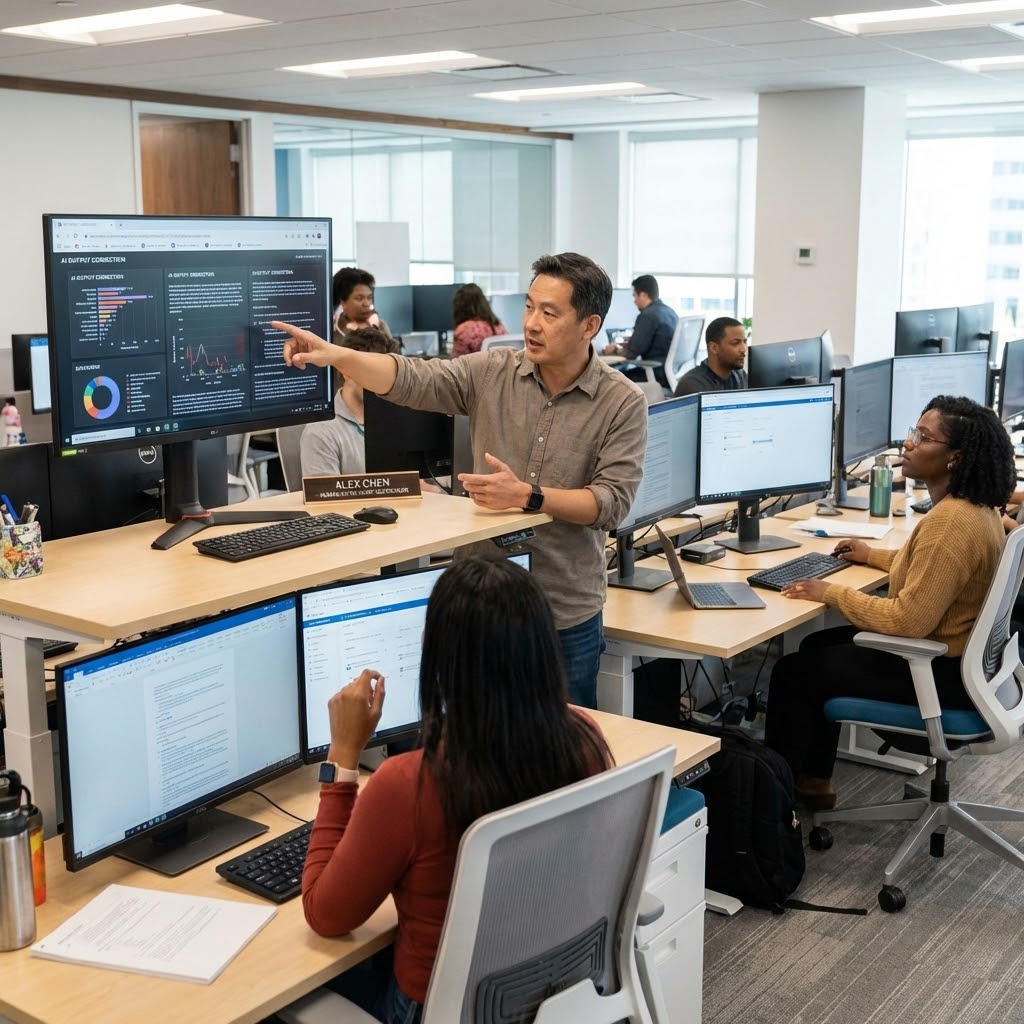
Human-in-the-Loop Supervisor
A speculative career prediction for AI Revolution based on technological trends and societal evolution.
Media Gallery
Image

AI Revolution
A speculative career prediction for AI Revolution based on technological trends and societal evolution.
In the rapidly evolving landscape of the AI Revolution, the role of the Human-in-the-Loop Supervisor emerges as a pivotal position that bridges the gap between human intuition and machine learning algorithms. As artificial intelligence systems become increasingly sophisticated, the need for human oversight to ensure ethical decision-making, contextual understanding, and nuanced judgment becomes paramount. This role is not merely about managing AI systems; it is about enhancing their capabilities through human insight, ensuring that technology serves humanity's best interests.
The Human-in-the-Loop Supervisor is tasked with overseeing AI operations across various sectors, from healthcare to autonomous vehicles, ensuring that AI systems operate within ethical boundaries and align with societal values. This position requires a deep understanding of both technology and human behavior, as supervisors must interpret AI outputs, provide feedback for continuous learning, and intervene when necessary to prevent errors or biases. As AI systems learn from vast datasets, the supervisor's role is to ensure that these datasets are representative and free from harmful biases, thus safeguarding against unintended consequences.
In this future job, supervisors will also play a crucial role in training AI systems, providing the necessary context and real-world knowledge that machines often lack. They will collaborate with data scientists and engineers to refine algorithms, ensuring that AI systems not only perform efficiently but also ethically. The Human-in-the-Loop Supervisor will be at the forefront of a new era of responsible AI deployment, advocating for transparency, accountability, and inclusivity in technology development.
The day begins with a review of the previous day's AI outputs. The Human-in-the-Loop Supervisor analyzes reports generated by AI systems, assessing their accuracy and relevance. This involves scrutinizing data patterns, identifying anomalies, and ensuring that the AI's decisions align with ethical standards. A morning meeting with the data science team allows for collaborative discussions on any discrepancies and the need for adjustments in the algorithms.
Following the analysis, the supervisor conducts training sessions for AI systems. This involves feeding the AI with new data sets, particularly those that reflect diverse perspectives and scenarios. The supervisor provides contextual knowledge that the AI lacks, ensuring that the machine learning models are well-rounded and capable of making informed decisions. This is a critical part of the job, as it directly impacts the AI's learning trajectory.
In the afternoon, the supervisor meets with stakeholders from various departments—such as ethics boards, legal teams, and user experience designers—to discuss the implications of AI decisions. These meetings are essential for aligning AI operations with organizational values and societal expectations. The supervisor presents findings from the morning analysis and discusses potential improvements, fostering a culture of transparency and collaboration.
As the day winds down, the supervisor monitors real-time AI operations, ready to intervene if necessary. This could involve halting an AI-driven process that is producing biased results or adjusting parameters to enhance performance. The supervisor's ability to make quick, informed decisions is crucial in maintaining the integrity of AI systems.
Before concluding the day, the supervisor dedicates time to personal development, staying updated on the latest advancements in AI technology and ethical guidelines. This commitment to continuous learning ensures that they remain effective in their role, adapting to the ever-changing landscape of AI.
As humanity ventures beyond the confines of Earth, the role of the Space Tourism Guide emerges as a pivotal profession in the burgeoning industry of space travel. These guides are not merely tour leaders; they are educators, safety officers, and cultural ambassadors, tasked with ensuring that the experience of space travel is both exhilarating and safe for the adventurous tourists who dare to leave the planet. Imagine a world where individuals from all walks of life can book a trip to the edge of space, experiencing the breathtaking view of Earth from above, the sensation of weightlessness, and the thrill of traveling at incredible speeds. The Space Tourism Guide is there to facilitate this journey, providing insights into the science of space travel, the history of human exploration, and the environmental considerations of our ventures into the cosmos. Guides will be equipped with advanced training in astrophysics, emergency protocols, and customer service, ensuring that every traveler feels informed and secure. They will also play a crucial role in promoting sustainable practices in space tourism, advocating for responsible exploration that respects the delicate balance of our universe. As the industry grows, so too will the responsibilities of the Space Tourism Guide, who will need to adapt to new technologies and evolving safety standards, all while fostering a sense of wonder and respect for the cosmos among their clients.
In the Climate Adaptation Era, the role of a Circular Economy Strategist emerges as a pivotal force in reshaping industries and communities towards sustainability. This innovative profession is dedicated to designing and implementing systems that minimize waste, maximize resource efficiency, and promote the continual use of materials. Circular Economy Strategists work at the intersection of environmental science, economics, and social responsibility, crafting strategies that not only benefit businesses but also contribute to the health of our planet. They are the architects of a new economic model that prioritizes regeneration over depletion, ensuring that products are designed for longevity, reuse, and recycling. As advocates for sustainable practices, they engage with stakeholders across various sectors, from manufacturing to retail, to foster a culture of sustainability that permeates every level of the supply chain.
Discover the full collection of past and future professions in The Jobs Museum.