Industrial Revolution
Map Engraver
An extinct profession from Industrial Revolution that became obsolete due to technological advancement and societal change.
Media Gallery
Image

Industrial Revolution
An extinct profession from Industrial Revolution that became obsolete due to technological advancement and societal change.
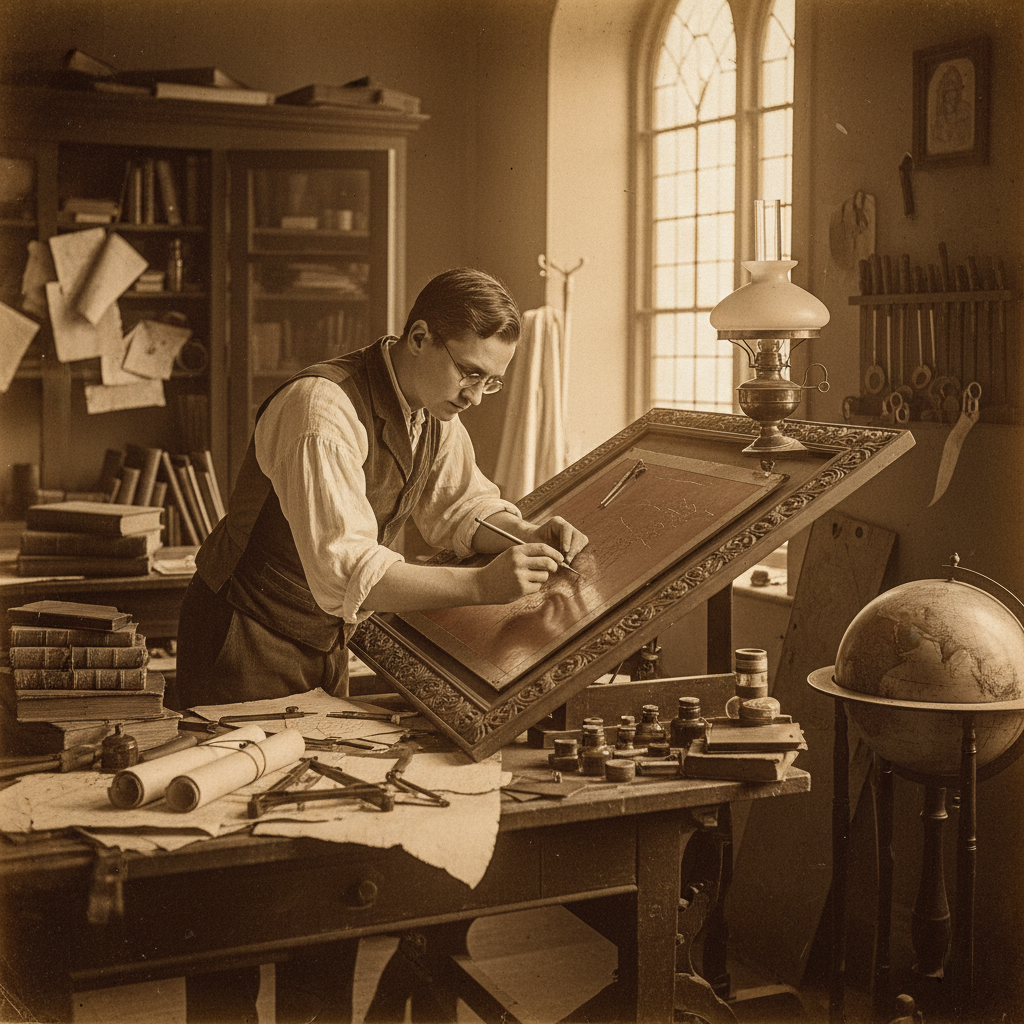
Map engravers were skilled artisans responsible for the intricate task of transferring cartographic designs onto metal plates, which were then used for printing maps. This occupation flourished during the Industrial Revolution, a period marked by rapid advancements in technology and a growing demand for accurate geographical representations. The engraver's work was crucial for the production of maps that guided explorers, navigators, and the general public, reflecting the expanding knowledge of the world and the increasing importance of navigation in trade and exploration.
The process of map engraving was meticulous and required a deep understanding of both art and science. Engravers would begin with a detailed drawing of the map, often created by cartographers who specialized in the art of map-making. Using tools such as burins and gravers, the engraver would carve the design into a copper or zinc plate, creating a reverse image of the map. This required not only precision but also an artistic eye to ensure that the final product was both accurate and aesthetically pleasing. Once the engraving was complete, the plate would be inked and pressed onto paper, producing the final map that would be distributed for use.
Map engravers played a vital role in the dissemination of knowledge during a time when maps were essential for navigation, land ownership, and military strategy. Their work contributed to the Age of Exploration, as accurate maps were crucial for explorers venturing into uncharted territories. As such, map engravers were respected members of the printing and publishing industries, often working closely with publishers and cartographers to produce high-quality maps for various purposes, including atlases, travel guides, and educational materials.
The day would typically begin early, with the map engraver arriving at the workshop before the sun fully rose. The first task was to prepare the workspace, ensuring that all tools were clean and ready for use. The engraver would lay out the copper or zinc plates, along with the necessary tools: burins, gravers, and ink. A careful review of the day’s projects would follow, often involving discussions with cartographers about the specifics of the maps to be engraved.
Once the workspace was set, the engraver would begin the intricate process of engraving. This required intense concentration and a steady hand, as each line and detail had to be carved with precision. The engraver would often work from a detailed drawing, carefully translating the cartographer’s vision onto the metal plate. This could take several hours, depending on the complexity of the map.
After completing the engraving, the engraver would clean the plate and prepare it for inking. This involved applying ink to the engraved surface, ensuring that the ink filled the carved lines. Once the plate was inked, it was placed in a printing press, where paper was pressed against it to create the final map. The engraver would inspect the first prints, making adjustments if necessary to ensure quality.
The latter part of the day often involved collaboration with other artisans and cartographers. The engraver would discuss any challenges faced during the engraving process and review the printed maps for accuracy. Feedback from publishers and clients was crucial, as maps needed to meet high standards of quality and precision.
As the day wound down, the engraver would clean and maintain their tools, preparing for the next day’s work. This was also a time for planning future projects, as the demand for new maps continued to grow with the expansion of trade and exploration. The engraver would often reflect on the day’s work, proud of their contribution to the world of cartography and navigation.
The art of calligraphy, often referred to as 'beautiful writing,' flourished during the Medieval Period, where skilled calligraphers played a crucial role in the preservation and dissemination of knowledge. These artisans were not merely writers; they were artists who transformed the written word into a visual spectacle. Calligraphers were responsible for creating manuscripts, religious texts, and important documents, often using intricate scripts that varied by region and purpose. Their work was characterized by the use of quills, ink, and parchment, and they often employed elaborate techniques such as gilding and illumination to enhance their creations. The calligrapher's role was not only to write but to imbue each piece with a sense of beauty and reverence, making their work essential in an era where printed materials were scarce and literacy was a privilege of the few.
In the bustling urban landscapes of the late 19th and early 20th centuries, the elevator operator emerged as a vital figure in the daily operations of skyscrapers and multi-story buildings. These skilled individuals were responsible for the safe and efficient transport of passengers between floors, often in ornate, manually operated elevators that were a marvel of engineering at the time. With a keen understanding of the building's layout and a friendly demeanor, elevator operators greeted patrons, assisted them in entering and exiting the elevator, and ensured that the doors closed securely before ascending or descending. Their role was not merely mechanical; it was a blend of customer service and technical skill, as they had to manage the intricate workings of the elevator machinery, often using a lever or a set of controls to navigate the complex system of pulleys and cables. The elevator operator was a familiar face in the urban environment, often dressed in a crisp uniform, complete with a cap, and sometimes even a badge indicating their position. They were the gatekeepers of vertical transportation, providing a personal touch in an increasingly mechanized world.
Discover the full collection of past and future professions in The Jobs Museum.